
Resources
Grease Trap vs. Grease Interceptor: What's the Difference?
People use the terms interchangeably — even in the industry — but there's a practical difference that affects how often you need service and what it costs.
Grease traps (hydromechanical)
Small units, typically 20–100 gallons, installed indoors under or near the sink. They rely on baffles and flow restriction to separate grease in a compact space. Because they're small, they fill fast: busy kitchens may need cleaning every 1–4 weeks. Common in smaller cafés, coffee shops, daycares, and older buildings.
Grease interceptors (gravity)
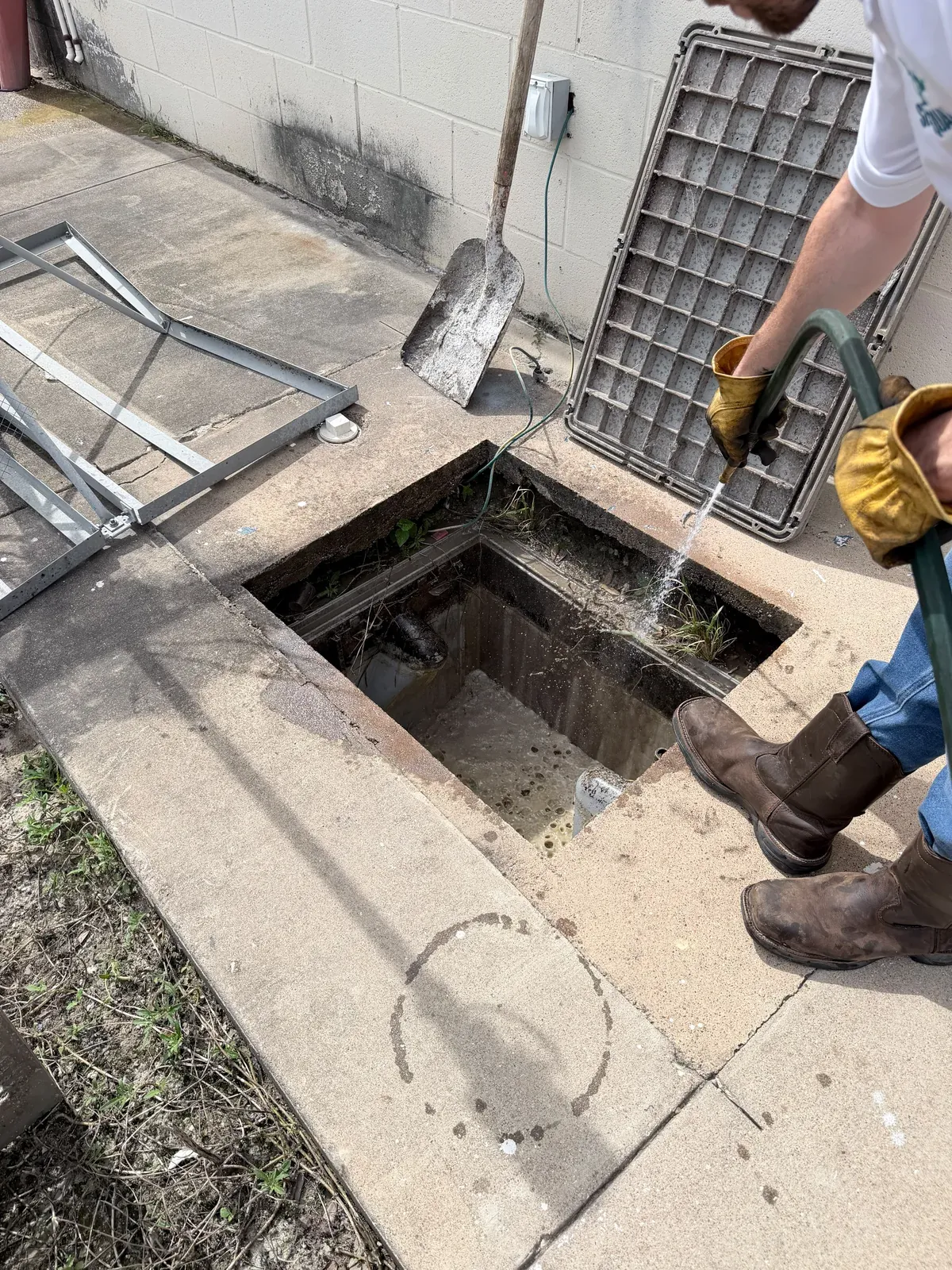
Large in-ground tanks — commonly 500 to 3,000+ gallons — installed outside, usually in the parking lot or drive lane under manhole-style lids. Their size gives wastewater time to separate properly, so they typically need professional pumping every 30–90 days. This is what most full-service restaurants and newer commercial buildings have.
Why the difference matters
- Service frequency and cost differ dramatically between a 50-gallon indoor trap and a 1,500-gallon interceptor
- Cleaning method differs: indoor traps can often be serviced by hand plus vacuum; interceptors require a vacuum truck
- Ordinances often set different requirements for each type
Not sure which you have?
If your unit is indoors and roughly the size of a filing cabinet, it's a trap. If crews open lids in your parking lot, it's an interceptor. Either way, Sewer Squad services both — completely, with documentation.